
Studies in Ḥanafī Legal Texts (I): Transmission and Authority in the Formative Period
Shaykh Salman Younas
Introduction
In his didactic poem on the juristic discipline of iftāʾ (the issuing of legal opinions), Ibn ʿĀbidīn (d. 1252/1836) outlines a three-tiered classification of authoritative sources within the Ḥanafī school. At the apex of this hierarchy stood ẓāhir al-riwāya, a term designating the legal opinions of Abū Ḥanīfa (d. 150/767), Abū Yūsuf (d. 182/798), and Muḥammad b. al-Ḥasan al-Shaybānī (d. 189/805) as transmitted through six works authored by Imam Muḥammad.[1] Among the various opinions attributed to the masters, those preserved in this corpus were regarded as the most authoritative on account of their wide and reliable transmission (mutawātir or mashhūr). For that reason, the corpus was also known as al-uṣūl, the “foundations”, since it supplied the bedrock upon which the school’s legal edifice was constructed.[2]
The second tier in Ibn ʿĀbidīn’s taxonomy comprises the nawādir, a body of opinions likewise traced to the Ḥanafī masters but distinguished by more limited transmission. Because these reports were not widespread, they were accorded a lower rank within the hierarchy of authority. The third and final category consists of the nawāzil. These were legal rulings formulated by later jurists to address cases for which no transmitted opinion from the Ḥanafī masters was available. Unlike the first two corpora, which preserved earlier doctrine, the nawāzil represented new derivations crafted in response to emerging circumstances.[3]
This tripartite taxonomy of legal sources only formally emerged in the classical stage of the Ḥanafï school. It did not arise fully formed in the formative period.[4] Rather, it was the product of a gradual historical process shaped by patterns of transmission, the canonization of texts, debates over doctrinal attribution, and sustained juristic activity. To examine the emergence of this taxonomy is therefore to explore how the Ḥanafī school defined the boundaries of authoritative doctrine, managed internal plurality, and institutionalized a structured hierarchy of legal sources.
The present essay traces the origins and precursors of this taxonomy during the formative period of the Ḥanafī tradition. In doing so, it serves as a conceptual introduction to a series of articles devoted to the individual texts and corpora that constitute this taxonomy, beginning with the works later designated as ẓāhir al-riwāya and extending to the nawādir and nawāzil literature. Before turning to those texts, it is essential to understand the history, origins, and evolution of this taxonomy itself and the intellectual needs it was designed to address.
Formative Foundations: Doctrinal Transmission & Evolving Authority
The intellectual origins of the Ḥanafī school are rooted in the teachings of Abū Ḥanīfa (d. 150/767), whose legal opinions were preserved, transmitted, and elaborated by his leading disciples, most notably Abū Yūsuf and Muḥammad. The latter in specific played a decisive role in shaping the school’s textual legacy by recording its doctrines in several texts, including those that would later be identified collectively as the corpus of ẓāhir al-riwāya.
In the early 3rd/9th century, however, the Ḥanafī community had no formalized hierarchy of legal opinions or sources. The term ẓāhir al-riwāya was absent, and juristic practice retained a significant degree of fluidity. The students of the Ḥanafī masters circulated their opinions, and these opinions sometimes differed with one another.[5] Concurrently, independent reasoning (ijtihād) remained a feature of legal deliberation.[6] As the transmitted opinions of the masters spread and subsequent generations of Ḥanafī jurists derived new rulings, the school’s doctrinal corpus expanded in both scope and diversity.
Yet patterns of transmission began to shape emerging conceptions of authority. This constituted the earliest phase in the gradual differentiation of more and less authoritative material within the school. Several of Imam Muḥammad’s texts circulated widely across Iraq, Transoxiana, Egypt, and the Maghrib, benefiting from sustained scholarly engagement and cross-regional transmission.[7] By contrast, other materials, often resembling classroom dictations or personal notes, remained geographically limited and lacked stable textual form. Soon, a text’s breadth of transmission would serve as a marker of reliability and authority within the school.
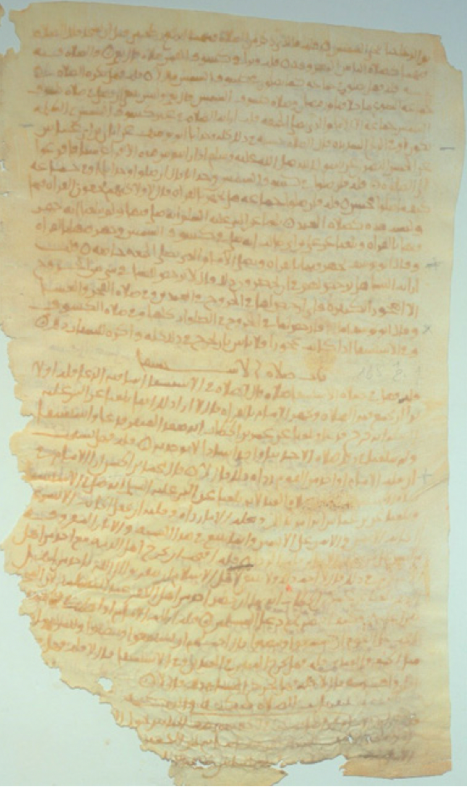
Fig. 1: Folio 1a of Kitāb al-Ṣalāt of al-Aṣl transmitted by Asad b. al-Furāt (d. 213/828) to the Maghrib.[8]
During the second half of the 3rd/9th century, the Ḥanafī school began to exhibit clearer signs of internal stratification in its legal corpus. Concerns about the reliability, status, and normative weight of transmitted opinions became more explicit. This development coincided with a broader transformation in the character of the school itself. As the Ḥanafī tradition evolved into a more self-conscious, socially bounded, and authoritative entity,[9] legal activity became increasingly oriented around the transmitted opinions of the Ḥanafī masters.[10] This growing reliance on transmitted doctrine made it necessary to define more precisely which opinions represented the madhhab and which could serve as the basis for fatwā. It is thus unsurprising that some of the earliest explicit questions from Ḥanafī jurists concerning textual authority appeared in this period, indicating that the problem of authoritative sources had begun to surface in concrete and practical terms within Ḥanafī legal discourse by the turn of the 4th/10th century.[11]
Within this movement towards doctrinal consolidation, several developments contributed to the ordering of the school’s transmitted opinions, which would later be expressed as the classical three-tiered Ḥanafī taxonomy. Among these developments were (a) the rise of evaluative terminology to classify opinions; (b) the articulation of a distinction between al-uṣūl and al-nawādir; and (c) the production of commentaries on selected texts. These developments reflected an effort to identify a more stable core of authoritative material and manage plurality within a cumulative doctrinal tradition. Together, they contributed to the construction of a structured framework of authority that paved the way for the crystallization of a formal taxonomy of legal sources, most notably the doctrine of ẓāhir al-riwāya.
Evaluative Terminology and the Ranking of Transmitted Opinions
One of the clearest indicators of a sharpening concern with authority in the Ḥanafī school appears in the second half of the 3rd/9th century with the emergence of evaluative terminology. Jurists began to classify the transmitted opinions of the Ḥanafī masters using terms such as ṣaḥīḥ (sound), ḍaʿīf (weak), maḥfūẓ (preserved), marjūʿ (retracted), awlā (preferred), and, most significantly, mashhūr (well-known).[12] In a context marked by growing doctrinal plurality and the strengthening of taqlid, where jurists increasingly confronted questions regarding the authoritativeness of differing opinions, evaluative terminology functioned as a mechanism for navigating and ordering plurality within this expanding body of inherited doctrine.
The concept of mashhūr is especially significant because it anticipates what ẓāhir al-riwāya would later come to denote. The earliest identifiable use of mashhūr appears in the middle of the 3rd/9th century,[13] and by the time of Abū Jaʿfar al-Ṭaḥāwī (d. 321/933) the term is employed with sufficient regularity to suggest that it was a recognized category within Ḥanafī discourse.[14] By the 4th/10th century, the identification of opinions as mashhūr had become a routine feature in Ḥanafī legal writing. This emphasis on widespread transmission captures the core logic that would later underpin ẓāhir al-riwāya: a body of doctrine not merely attributed to the masters but broadly circulated. In this respect, the mashhūr represents a conceptual bridge between early efforts to privilege well-known opinions and the later formalization of that privileging within a more clearly defined and increasingly authoritative taxonomy of sources.
The Uṣūl-Nawādir Distinction
Alongside the rise of evaluative terminology, another development that signalled the gradual ordering of Ḥanafī doctrine was the emergence, and increasing juxtaposition, of al-uṣūl and al-nawādir. Early usages of al-uṣūl, as well as related expressions such as riwāyat al-uṣūl and kutub al-uṣūl, appear in the works of 4th/10th century jurists like al-Ṭaḥāwī and Abū Bakr al-Jaṣṣāṣ (d. 370/981). In many instances, the term seems to refer to Imām Muḥammad’s al-Aṣl, though it is not always clear whether it always denoted that text narrowly or whether it was sometimes used more broadly for a group of texts. By contrast, nawādir consistently referred to opinions of the masters not included in Imam Muḥammad’s major texts, often preserved in separate collections.[15]
Although the precise contours of al-uṣūl were not yet fixed, the term carried connotations of textual centrality and authority. For example, opinions in al-uṣūl often overlapped with those described as mashhūr and rulings transmitted from the masters were judged by jurists considering what was related in al-uṣūl.[16] As such, like the concept of mashhūr, the uṣūl-nawādir distinction functioned as an important precursor to the later Ḥanafī taxonomy of authoritative doctrine by providing jurists with a vocabulary for distinguishing between genres of transmitted material. In later periods, the term al-uṣūl would become synonymous with ẓāhir al-riwāya.
The Rise of Commentaries
A further development that contributed to the emergence of the classical Ḥanafī taxonomy was the rise of commentary literature. From the late 3rd/9th century onward, key texts of Imam Muḥammad, especially al-Jāmiʿ al-ṣaghīr and al-Jāmiʿ al-kabīr, began to attract sustained attention. The decision to comment upon particular texts was not incidental. Rather, writing commentaries on earlier works was to acknowledge that some of them had “incomparably more weight than anything coming after.”[17]
Table: Early Commentaries on al-Jamiʿ al-kabīr[18]
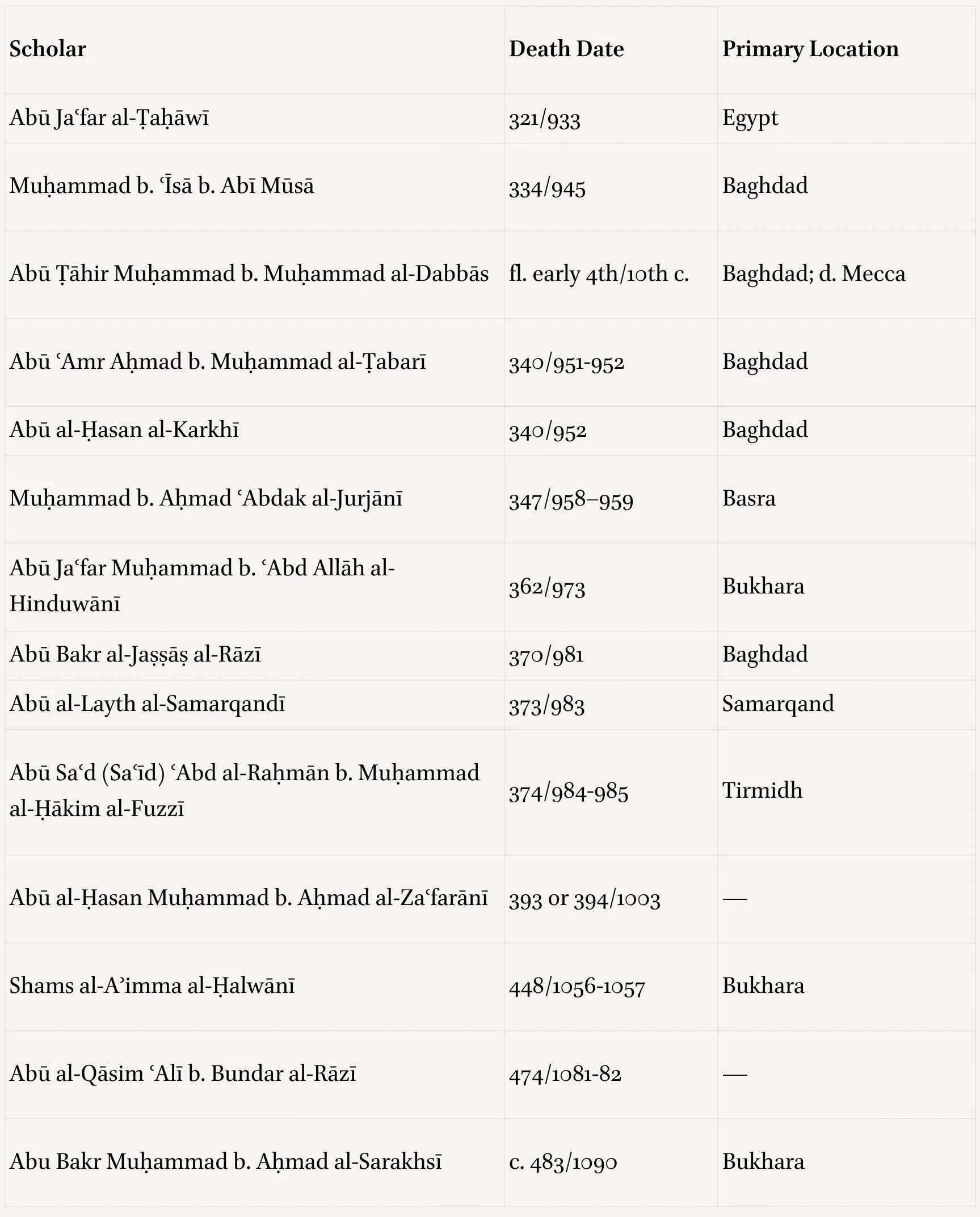
Commentary played an important role in stabilizing and consolidating the transmitted legal material of the school. Texts like al-Jāmiʿ al-ṣaghīr and al-Jāmiʿ al-kabīr were either terse, elliptical, or complex. Through commentary, jurists unpacked rulings, reconciled apparent tensions, clarified technical ambiguities, compared variant opinions, and articulated principles implicit in the texts. In doing so, they made the internal logic of these texts more explicit and integrated them more fully into the school’s developing doctrinal and pedagogical frameworks.[19]
This sustained exegetical engagement did not simply explain texts, it also contributed to their canonisation. As successive generations of jurists taught, interpreted, and debated these works, they became entrenched as central reference points for teaching and articulating the doctrine of the school. The repeated scholarly investment in a defined set of texts had the practical effect of narrowing the field of authoritative reference and reinforcing the perception that these works most reliably embodied the school’s cumulative inheritance. Long before a formal taxonomy of sources was articulated, commentary had already helped to canonise particular texts within the Ḥanafī tradition.
In this manner, commentaries helped create the conditions under which the classical Ḥanafī taxonomy could emerge. By repeatedly returning to a defined set of texts, jurists implicitly distinguished them from other transmitted materials, such as nawādir and imlāʾ collections, that did not receive comparable attention. The effect of this process was the gradual centering of specific works within the school’s doctrinal consciousness. When the terminology of ẓāhir al-riwāya later appeared in the mid-4th/10th century, it did not introduce authority ex nihilo. Rather, it formalized distinctions that commentary practice had already helped to entrench.
Conclusion
The classical tripartite taxonomy of ẓāhir al-riwāya, nawādir, and nawāzil was the outcome of a gradual process unfolding over the 3rd/9th and 4th/10th centuries. The developments examined in this study – patterns of transmission, the rise of evaluative terminology, the increasing juxtaposition of al-uṣūl and al-nawādir, and the canonizing force of commentary literature – collectively reflect a sustained effort to identify, stabilize, and privilege a core body of transmitted doctrine within an expanding and internally diverse legal tradition.
At a deeper level, these developments signalled a transformation in the nature of the madhhab itself, as the Ḥanafī school moved from a relatively fluid community of jurists into a more self-conscious and authoritative doctrinal tradition. As the scope of independent ijtihād gradually narrowed, the transmitted opinions of the Ḥanafī masters became the primary object of interpretation, organization, and elaboration. Commentary, classification, and textual differentiation were natural consequences of this shift and integral to the institutionalization of the madhhab as a doctrinal entity with defined boundaries and structured authority. The later crystallization of the Ḥanafī taxonomy formalized distinctions already taking shape through transmission, classification, and exegetical practice. To understand these formative developments is therefore to understand how the Ḥanafī school came to conceive of itself not merely as a community of jurists, but as a cumulative and authoritative legal tradition.
Notes
[1] These texts are al-Aṣl, al-Jāmiʿ al-kabīr, al-Jāmiʿ al-ṣaghīr, al-Siyar al-kabīr, al-Siyar al-ṣaghīr (seen by many now as part of al-Aṣl), and al-Ziyādāt. Though these were generally identified with ẓāhir al-riwāya, there was disagreement among Ḥanafī jurists on the texts that made up this corpus. Some opined that the number of ẓāhir al-riwāya texts were three, while others said four or five. See further Lu’ay ʿAbd al-Ra’ūf al-Khalīlī, Asbāb ʿudūl al-ḥanafiyya ʿan al-futyā bi-ẓāhir al-riwāya (Amman: Dār al-Fatḥ, 2016), 45-64.
[2] Muḥammad Amīn b. ʿĀbidīn, Sharḥ ʿuqūd rasm al-muftī, ed. Shanūl Ṣaylān (Istanbul: ISAM, 2020), 87-88.
[3] Ibid., 89-93.
[4] The formative period concluded in the early 4th/10th century.
[5] In his historical periodization of the Ḥanafī school, Talal Al-Azem identifies the 3rd/9th century as an era of formative transmission. See Talal Al-Azem, Rule-Formulation and Binding Precedent in the Madhhab-Law Tradition: Ibn Quṭlūbughā’s Commentary on The Compendium of Qudūrī, Islamicate Intellectual History 2 (Leiden: Brill, 2016), 57-59.
[6] This was common in the formative period, which has been described as displaying a restricted school-consciousness where the masters are seen exerting a strong influence on subsequent generations of jurists, but where these jurists are also willing to consider legal matters independently of these eponymic figures, even at the expense of disagreeing with them.
[7] For example, al-Jāmiʿ al-kabīr was transmitted in Iraq by Abū Sulaymān (d. after 200/815), in Transoxiana by Abū Ḥafṣ al-Kabīr (d. 217/832), in Rayy by Hishām b. ʿUbayd Allāh (d. 221/835), and in Egypt ʿAlī ibn Maʿbad (d. 218/833). See Salman Younas, “The Ḥanafī School: A Study of Its Social & Legal Dimensions, 189/805-340/952” (PhD Diss., University of Oxford, 2018), 32.
[8] Nejmeddine Hentati, Ḥanafī Fiqh in Ifrīqiya in the 3rd/9th Century: Scholarly Transmissions of Asad b. al-Furāt from Muḥammad b. al-Ḥasan al-Shaybānī, Arabic and Islamic Civilization 7 (Leiden: Brill, 2024).
[9] The classical madhhab, which emerged in the 4th/10th century, was properly speaking a “doctrinal school”. A doctrinal school possessed several features, such as a cumulative body of law, a distinctive methodology, substantive boundaries defining the outer limits of the school, which necessitated loyalty to the school (taqlīd), and, most importantly, an axis of authority in the form of a school eponym around whom these features were fashioned. These features emerged gradually throughout the course of the 2nd/8th and 3rd/9th centuries. See Wael Hallaq, The Origins and Evolution of Islamic Law (Cambridge: Cambridge University Press, 2004), 156-57.
[10] This should be understood as part of the move from an era of independent ijtihād to one of taqlīd.
[11] “What do you say, may Allah have mercy upon you, concerning the following four legal texts, the Kitāb of Ibrāhīm b. Rustum, Adab al-qāḍī of al-Khaṣṣāf, al-Mujarrad, and al-Nawādir of Hishām? Is it permitted for us to issue legal rulings based on these texts or not?” This question was posed to Abū Naṣr al-Balkhī (d. 305/917-18). Three of the texts mentioned in this report, namely the legal texts of Ibn Rustum (d. 211/826-27), al-Ḥasan b. Ziyād (al-Mujarrad), and Hishām, were identified in later taxonomies as belonging to the nawādir genre, a corpus that was deemed less authoritative than ẓāhir al-riwāya. Importantly, Abū Naṣr ‘s response refers to legal opinions that were well-known (ishtaharat) and manifest (zaharat) from the Ḥanafī masters as one’s meriting reliance. See Naṣr b. Muḥammad al-Samarqandī, al-Fatāwā min aqāwīlal-mashāyikh fī al-aḥkām al-sharʿiyya, ed. Muḥammad Sālim Hāshim (Beirut: Dār al-Kutub al-ʿIlmiyya, 2017), 729.
[12] Younas, “The Ḥanafī School”, 225-242.
[13] al-Haytham b. Sulaymān al-Qaysī, Adab al-qāḍī wa’l-qaḍā’, ed. Farāḥat al-Dishrāwī (Tunis: al-Sharikat al-Tunisiyya lil-Tawzīʿ, 1975), 94.
[14] Abū Jaʿfar al-Ṭaḥāwī, Sharḥ maʿānī al-āthār, ed. Muḥammad Zuhrī Najjār and Muḥammad Sayyid Jād al-Ḥaqq, 5 vols. (Beirūt: ʿĀlam al-Kutub, 1994), 1:491, 3:99, 103, 309, 4:19.
[15] Salman Younas, “Authority in the Classical Ḥanafī School: The Emergence & Evolution of Ẓāhir al-Riwāya” in Islamic Law & Society (2021): 1-65, at 11-14.
[16] Ibid., 13.
[17] Christopher Melchert, The Formation of the Sunni Schools of Law, 9th-10th Centuries C.E. (Leiden: Brill, 1997), 60.
[18] Ibid.,60-83.
[19] Thus, Dr Sohail Hanif observed that in the early classical period of the Ḥanafī school“these texts maintained their authoritative status into the sixth-century Transoxiana… We saw in al-Marghīnānī’s biography that a study of al-Shaybānī’s main written works, including these two Jāmi‘s, was a central part of the Transoxianan teaching curriculum.” See Sohail Hanif, “A Theory of Early Classical Ḥanafism: Authority, Rationality and Tradition in the Hidāyah of Burhān al-Dīn ‘Alī ibn Abī Bakr al-Marghīnānī (d. 593/1197)” (PhD Diss., University of Oxford, 2017), 106.
Dr. Salman Younas serves as a faculty member at the Qalam Seminary. He graduated from Stony Brook University with a degree in Political Science and Religious Studies. After studying introductory Islamic sciences with local scholars in North America, Shaykh Salman moved to the Middle East where he spent several years studying the Islamic sciences. He then moved to England to pursue a PhD in Islamic Studies from the University of Oxford where his thesis focused on the formation and evolution of the early Ḥanafī legal school. Previously, Shaykh Salman was the Hamad bin Jassim Fellow at the Oxford Centre for Islamic Studies and a researcher at the Oxford Department of International Development.
